Let’s Be Direct About What “Natural Flavor” Really Means
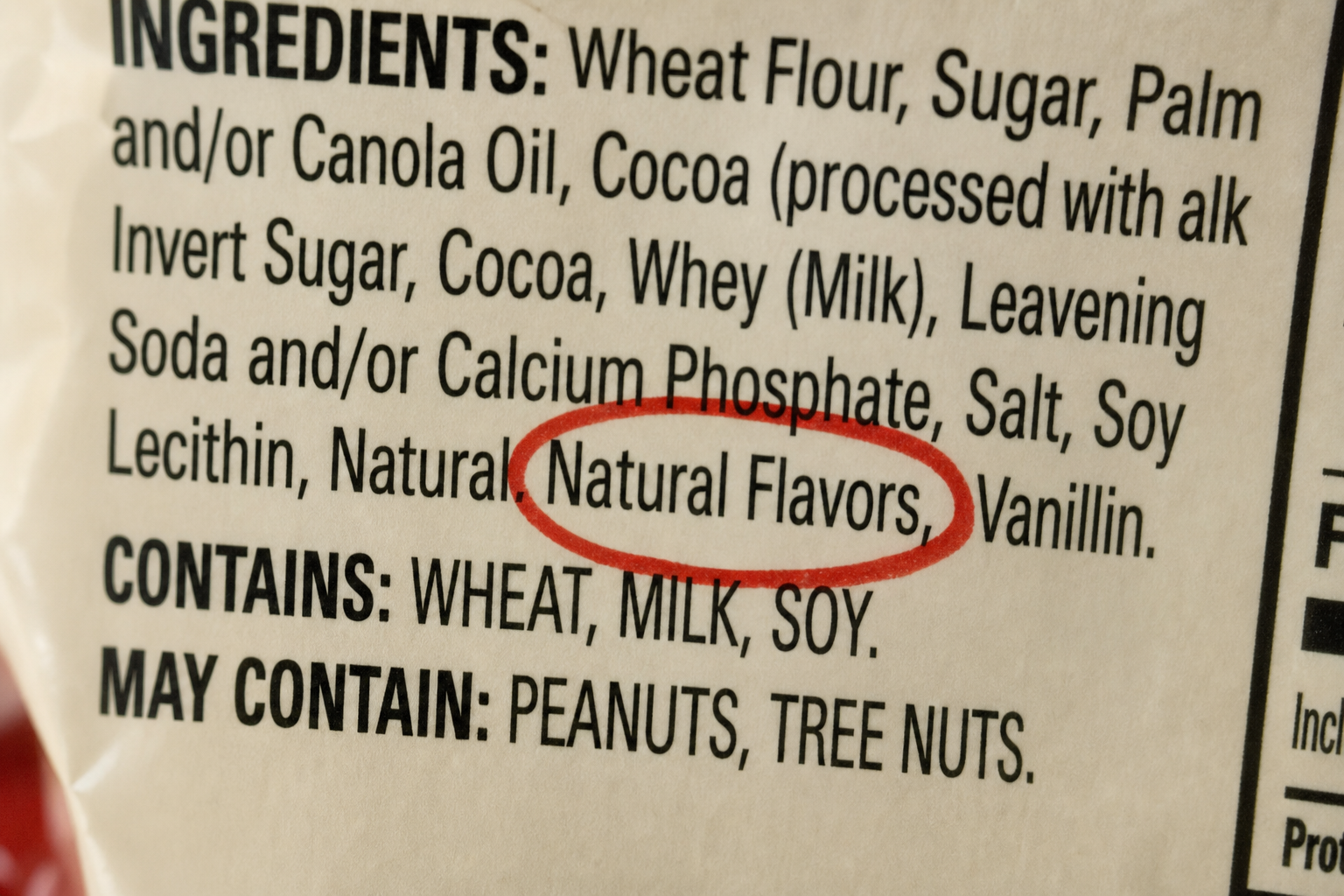
Two words, printed in tiny type near the bottom of an ingredient list, and most of us walk right past them. “Natural flavor” reads like a green light — reassuring, familiar, the one you don’t need to think twice about. That reassurance isn’t earned, and it isn’t a safety verdict either: “natural” doesn’t mean safer than “artificial,” any more than “artificial” means more dangerous than “natural.” It’s a legal label, and once you understand what the law actually requires, it stops looking like a health claim and starts looking like exactly what it is: a category built for manufacturers, not for shoppers trying to make an informed choice.
This isn’t about fear. It’s about facts — the kind that let you decide for yourself what belongs in your pantry.
The Legal Definition Isn’t What You Think
Under FDA regulation 21 CFR 101.22, a “natural flavor” is defined as an essential oil, oleoresin, essence, extractive, protein hydrolysate, distillate, or product of roasting, heating, or enzymolysis — as long as its flavoring component is derived from a spice, fruit, vegetable, yeast, herb, bark, root, meat, seafood, dairy, or similar source, rather than being added for nutritional value.
Read that again: the distinction between “natural” and “artificial” is about where the flavor molecule originated, not how it was made or how heavily it was processed. A natural flavor can be extracted, distilled, chemically isolated, and reconstructed in a lab — often by the same flavor chemists, in the same facilities, using many of the same processes as an artificial flavor. The difference the label draws isn’t “processed vs. unprocessed.” It’s a paperwork trail back to a natural source. That’s a meaningfully narrower claim than most people assume it’s making.
You Can’t Know What’s Actually In It
Here’s the part that deserves real skepticism: a “natural flavor” on a label is almost never one single compound. It’s typically a proprietary blend — sometimes dozens of chemical constituents — of which only a portion needs to trace back to the named natural source to legally qualify for the label. The full formulation isn’t disclosed. It’s treated as a trade secret, protected the same way a company protects a recipe from competitors, which means you, the person eating it, have no way to see the actual composition.
On top of that, FDA’s incidental-additive exemption (21 CFR 101.100) allows solvents, carriers, emulsifiers, and preservatives used to manufacture and stabilize a flavor — things like propylene glycol — to go unlisted on the label entirely, as long as they’re present at a level with no functional effect in the finished food. If the residual amount does have a functional effect, it has to be declared. But the threshold for “functional” is a technical judgment made by the manufacturer, not something a shopper can verify from the shelf.
The Hidden Glutamate Problem
If you’ve ever avoided a product because it listed MSG, only to eat something with “yeast extract” or “natural flavor” without a second thought, it’s worth knowing this: ingredients like autolyzed yeast, hydrolyzed yeast, yeast extract, and hydrolyzed vegetable protein naturally contain free glutamate — the same compound that gives MSG its flavor-enhancing effect. The FDA is clear that products containing these ingredients cannot claim “No MSG” or “No added MSG,” and if MSG itself is added, it must be listed by name. But there’s no requirement to flag that an ingredient like yeast extract naturally contains free glutamate. A product marketed as “no MSG, all natural flavors” can still deliver a comparable glutamate load — legally, and without ever using the letters M-S-G.
Who’s Actually Deciding These Ingredients Are Safe
This is the fact that surprises most people: the safety of the vast majority of flavor ingredients used in U.S. food doesn’t run through FDA premarket approval. It runs through the FEMA Expert Panel — a panel convened and funded by the Flavor and Extract Manufacturers Association, the flavor industry’s own trade group. Manufacturers submit ingredients to this panel, the panel evaluates them, and the results are shared with the FDA — but the FDA does not formally approve these determinations. The agency can challenge a finding if it chooses to, but the default is industry self-affirmation, not independent government review. That’s not a conspiracy theory; it’s how the GRAS (“Generally Recognized As Safe”) system for flavors has functioned for decades, and it’s exactly why regulators and lawmakers are now pushing to change it — as of August 2026, the FDA has proposed making GRAS notification mandatory instead of voluntary, and separate legislation (the Food Labeling Modernization Act) specifically targets the vague “natural flavor” and “spices” catchalls on ingredient lists. None of this is settled law yet, but it tells you the current system is under real, active scrutiny — not a settled non-issue.
”Natural” Is Not a Nutrition Claim
This is worth saying plainly: nothing about the word “natural” on a flavor promises it’s healthier, safer, lower-calorie, or better for your body than an artificial alternative. It’s a sourcing category, not a nutrition label. A natural flavor can come from an animal product, making it unexpectedly non-vegan or non-vegetarian. It can be produced with the same industrial solvents as an artificial one. It tells you almost nothing about what you’re actually consuming — which is the whole point of understanding the definition instead of just trusting the word.
What You Can Actually Do
- ✔ Read past the word “natural.” Treat it as a legal category, not a green light. It doesn’t tell you what’s in the flavor, only where the flavor molecule traces back to.
- ✔ Favor short ingredient lists and whole foods. The fewer manufactured flavor systems in a product, the less you’re relying on undisclosed formulations.
- ✔ Watch for glutamate-heavy language if you’re sensitive to it. Yeast extract, autolyzed yeast, and hydrolyzed vegetable/soy protein can function like MSG in the body, even on a product labeled “no MSG.”
- ✔ Look for brands that voluntarily disclose flavor sourcing. Some companies publish full ingredient breakdowns or third-party certifications precisely because the legal minimum doesn’t require it — that voluntary transparency is worth rewarding with your purchase.
- ✔ Contact the manufacturer directly when it matters. If you have a food allergy, a religious dietary requirement, or MSG sensitivity, “natural flavor” alone isn’t enough information — a phone call or email to the company is the only way to get a real answer, since the label legally doesn’t have to give you one.
- ✔ Don’t confuse “natural” with “safe” or “healthy.” Judge a product by its actual nutrition — sugar, sodium, whole-food content — not by a single word on the front of the package.
The Bottom Line
“Natural flavor” isn’t a lie, but it isn’t the reassurance it’s designed to sound like either. It’s a narrow legal term that tells you almost nothing about processing, safety review, or what’s actually in the bottle — while letting the exact formulation stay a protected secret. Knowing that doesn’t mean panicking over every ingredient label. It means reading them with your eyes open, and putting your trust in transparency, not in a single reassuring word.
This information is intended to support informed wellness decisions and is not intended to diagnose, treat, cure, or prevent any disease.
Frequently Asked Questions
Are natural flavors vegan? Not necessarily. Because “natural flavor” can legally be derived from meat, seafood, poultry, eggs, or dairy sources, a product carrying that label isn’t automatically vegetarian or vegan. If that matters to you, the ingredient list alone won’t confirm it — check for a vegan certification or contact the manufacturer directly.
Is “natural flavor” the same as MSG? Not exactly, but they can behave similarly. Natural flavor extracts like yeast extract and hydrolyzed vegetable protein naturally contain free glutamate, the same flavor-active compound in MSG, even though the product isn’t required to say “MSG” or “contains glutamate.” If you’re sensitive to added MSG, it’s reasonable to treat these ingredients with the same caution.
How do I avoid unknown natural flavors? Choose products with short, plain-language ingredient lists where you recognize every item, look specifically for brands that publish full flavor-sourcing disclosures, and when an allergy or dietary restriction is at stake, contact the manufacturer directly — the label alone isn’t required to give you the full picture.
Does “natural” mean a product is healthier? No. “Natural” as used in “natural flavor” is a legal sourcing category defined by where the flavor molecule came from, not a claim about nutrition, calories, or overall healthfulness. Evaluate a product by its actual nutrition facts, not by that single word.